
12 marketing strategies for coaches, creatives, and small business owners, and how to choose the one you’ll actually do consistently.
IN THIS POST
Your website is the party. Marketing is the invitation.
12 marketing strategies for coaches, creatives, and small business owners (with pros, cons, and who each one is best for)
How to choose the right strategy for you
Going live sounds like such a momentous occasion. You imagine that the second you go live, people will come flocking to your website. I actually wish that were true! Unfortunately, it looks more like this…
You hit publish, and you wait, and you wait.
And… crickets.
Which raises the question: how are you sending people to your website?
If you thought clients would magically appear, this blog post is for you.
A quick note if you’ve been resisting marketing your business: 30 years ago, we didn’t even have this opportunity. There was no internet, no social media, and definitely no smartphones. Today, you can reach the exact people you want to help from your laptop or your phone. Think of marketing as a means to an end. It’s simply how you reach the people you’re here to help.
Your website is the party. Marketing is the invitation.
Think of your website as a party you’re hosting in your home. You've prepared a buffet of food, created flower arrangements, and made a great playlist. Everything is ready to welcome people into your home and you’re excited to share what you’ve lovingly prepared for them.
The thing is… you never sent the invitations.
That's what marketing is. Your website is where people come to get to know you, see what you offer, and take the next step with you. Your marketing strategies are the invitations that let the right people know the party is happening (and why they'd want to be there). Together, your website and your invitations make up your marketing ecosystem: the connected system that helps the right people find you, get to know you, and eventually work with you.
The good news is you don't need to send invitations in every possible way. A couple of thoughtful, well-chosen invitations will fill the room faster than a dozen half-hearted ones scattered everywhere. So let's look at your options.

Marketing strategies for coaches, creatives, and small business owners
As you read through these, notice which ones make you think "ooh, I could do that" and which ones make you want to hide under a blanket.
1. SEO and blogging
Writing helpful content that answers the questions your ideal clients are typing into Google, so they find you when they search.
You might like this strategy if… you enjoy writing long-form content, you're patient (results aren’t instantaneous), and you want a more easeful way of puting yourself out there.
Pros
Brings in steady traffic for months or even years after you publish
Builds trust and showcases your expertise
Free, apart from your time
Cons
Slow to start. It can take 3–6 months or more to see real results
Needs consistency and a bit of keyword know-how
2. Social media
Showing up on platforms like Instagram, Facebook, LinkedIn, or TikTok to share content, start conversations, and point people back to your site.
You might like this strategy if… you enjoy creating short-form content, you're comfortable sharing a bit of your personality, and your ideal clients are already scrolling there.
Pros
Free to start, with a huge potential audience
Great for showing the person behind the business
Quick feedback on what resonates
Cons
Content disappears quickly, so it needs a regular rhythm, such as posting 3 times a week or more
Algorithm changes are out of your control
Can become a time suck (and a comparison trap)
3. Email marketing
Building a list of people who've raised their hand to hear from you, then staying in touch with a newsletter or email series.
You might like this strategy if… you'd rather talk to people (through your emails) who already resonate with what you do, and you want an audience no algorithm can take away.
Pros
You own your list
Often the highest-converting channel for selling offers
Creates trust and builds an ongoing relationship with your audience – they feel like they already know you even before they’ve ever met you
Cons
You need another strategy to grow the list in the first place
Requires a freebie or reason to sign up, plus regular emails
Watching people unsubscribe can be challenging, and it’s important to learn not to take it persoanlly
4. Pinterest
Using Pinterest as a visual search engine, creating pins that link back to your blog posts, freebies, or offers.
You might like this strategy if… your work is visual (design, photography, home, food, wellness, lifestyle) and you want the reach of search without the pace of social media.
Pros
Pins can drive traffic for months or years
Works like a search engine, so people are actively looking
Easy to batch and schedule ahead
Cons
Less useful for some niches, like B2B or very local services
Works best when you already have content to link to
If your content isn’t necessarily visual, this one can be tricky
5. YouTube and video
Creating videos that teach, inspire, or show your process, posted on YouTube or shared across platforms.
You might like this strategy if… you're comfortable on camera, you enjoy teaching, you explain things well, and you want people to feel like they know you before they ever book.
Pros
Builds trust and credibility quickly, because people see and hear you
YouTube is a search engine too, so videos keep getting found
One video can be repurposed into clips, posts, and blogs
Cons
More time and tools to film and edit
Can feel vulnerable if you're camera-shy
6. Podcasting (hosting or guesting)
Starting your own show, or being a guest on podcasts your ideal clients already listen to.
You might like this strategy if… you enjoy interviewing others or being interviewed yourself, you enjoy being in conversation with someone
Pros
Listeners spend 30–60 minutes with you, which builds trust
Guesting gets you in front of an established audience quickly
Great for networking with other business owners
Cons
Hosting your own show takes a real ongoing commitment
You have to do the work of either inviting people to your podcast or being invited to someone else’s podcast
Results from guesting can be hard to track
7. Networking and referrals
Building relationships with people who can send clients your way, through events, groups, past clients, and fellow business owners.
You might like this strategy if… you're a people person, you thrive on real conversations, and you'd rather have coffee than create content.
Pros
Referred clients already come in with a sense of trust
Relationships in and of themselves are such a gift
Low or no cost: all it takes is your time and genuine interest in others
Cons
Can feel draining if you're more introverted
Less predictable than other strategies
Hard to scale, since it depends on your personal time and energy
8. Collaborations and partnerships
Teaming up with businesses that serve the same audience: guest blog posts, joint workshops, summits, bundles, or Instagram lives.
You might like this strategy if… you love working with others and want to grow faster by sharing audiences.
Pros
Puts you in front of a new, pre-qualified audience
Builds credibility by association
Can be fun and energizing
Cons
Takes coordination and finding the right partners
Results depend partly on someone else's follow-through
9. Speaking, workshops, and webinars
Teaching live, whether online or in person, to show your expertise and invite attendees to the next step.
You might like this strategy if… you light up when you teach, and you want a strategy that can turn strangers into clients in a single session.
Pros
Positions you as the expert
Can turn attendees into clients quickly
Recordings can be reused as content or freebies
Cons
Requires preparation and comfort presenting
Attendance can be unpredictable, especially at first
10. Paid ads
Paying to put your offer in front of a targeted audience, on platforms like Facebook, Instagram, Google, or Pinterest.
You might like this strategy if… you have some budget to invest, you want results faster, and you already know your offer sells.
Pros
Fastest way to get eyes on your website
Very specific targeting
Easy to scale up what works
Cons
Costs money, and the traffic stops when you stop paying
There's a learning curve, and it's easy to waste money without a plan
Works best once your website and offer are already converting
11. Google Business Profile and local listings
Claiming and optimizing your free listing on Google (and directories like Yelp) so local customers find you in search and on Maps.
You might like this strategy if… you serve clients in a specific area, like a studio, shop, or local service.
Pros
Free and fairly quick to set up
Shows up exactly when locals are searching for what you offer
Reviews build trust fast
Cons
Only useful if you serve a local area
Needs ongoing reviews and updates to stay competitive
12. Substack
Publishing a newsletter (and optional blog, podcast, or community) on Substack, where readers subscribe for free or paid and can discover you through other writers' recommendations.
You might like this strategy if… you love writing, you want your newsletter and your content in one place, and the idea of being part of a community of creators and readers appeals to you.
Pros
Combines blogging and email marketing in one free, easy platform
Built-in discovery through recommendations, Notes, and the Substack app
Option to earn directly through paid subscriptions
You can export your subscriber list anytime
Cons
Less control over design and branding than your own website
Content lives on Substack, not your site, so you'll want to link the two
Takes consistent writing to build momentum
How to choose the right marketing strategy for you

It comes down to this: the best marketing strategy is the one you'll actually do.
A "perfect" strategy you dread will get abandoned in three weeks. A "good enough" strategy you enjoy, done consistently, will win every time. So instead of asking "what's the best strategy?", ask yourself these questions:
How much time do I really have each week? Two hours a week is plenty if you protect it.
What do I actually enjoy? Writing, talking, teaching, being on camera, meeting people?
Where do my ideal clients already spend time? Google, Instagram, LinkedIn, local events, podcasts?
Do I need clients soon, or am I building for the long term? Some strategies are quick, some are slow but lasting.
What's my budget? Time and money are both investments. Most strategies cost one or the other.
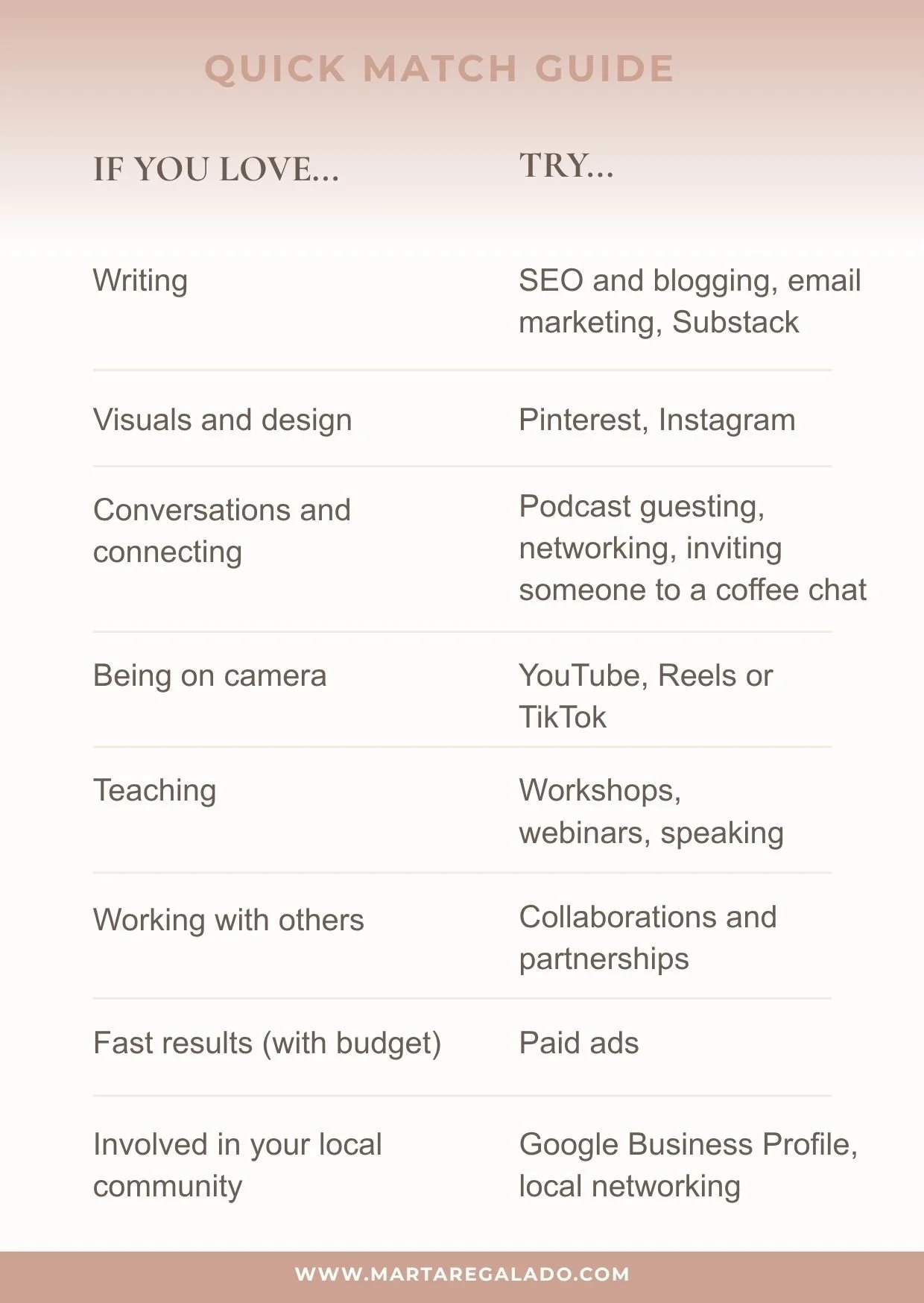
Keep it simple: pick two
You don't need to do it all. A simple, sustainable ecosystem looks like this:
One strategy to bring new people in, like blogging, Pinterest, social media, or podcast guesting
One strategy to stay in touch, which for most businesses is email
Commit to them for 90 days before you judge the results and give up. Pick one simple number to watch, like website visitors, email sign-ups, or discovery calls booked. Then keep what's working and tweak what isn't.
KEY TAKEAWAYS
Going live is the starting line, not the finish line. Your website needs a plan to bring people to it.
Your website is the party. Your marketing is the invitation. Without invitations, no one knows to show up.
You don’t need every strategy. One or two done well beat ten done halfway.
The best strategy is the one you’ll actually do. Choose based on your time, strengths, budget, and where your ideal clients already are.
Pick two to start: one to bring new people in, and one (usually email) to stay in touch.
Give it 90 days and track one simple number before deciding what’s working.
So… if you build it, will they come?
They will, if you send the invitations.
Your website is an incredible tool, but it can't do the work alone. Choose a strategy that fits your time, your strengths, and your personality, show up consistently, and give it time to grow. Crickets don't last forever.
Not sure which invitations to send? Let’s figure it out together. In a Strategy Session, we’ll look at your website, your goals, and how you like to show up, and map out the marketing strategies that fit you. No more crickets.