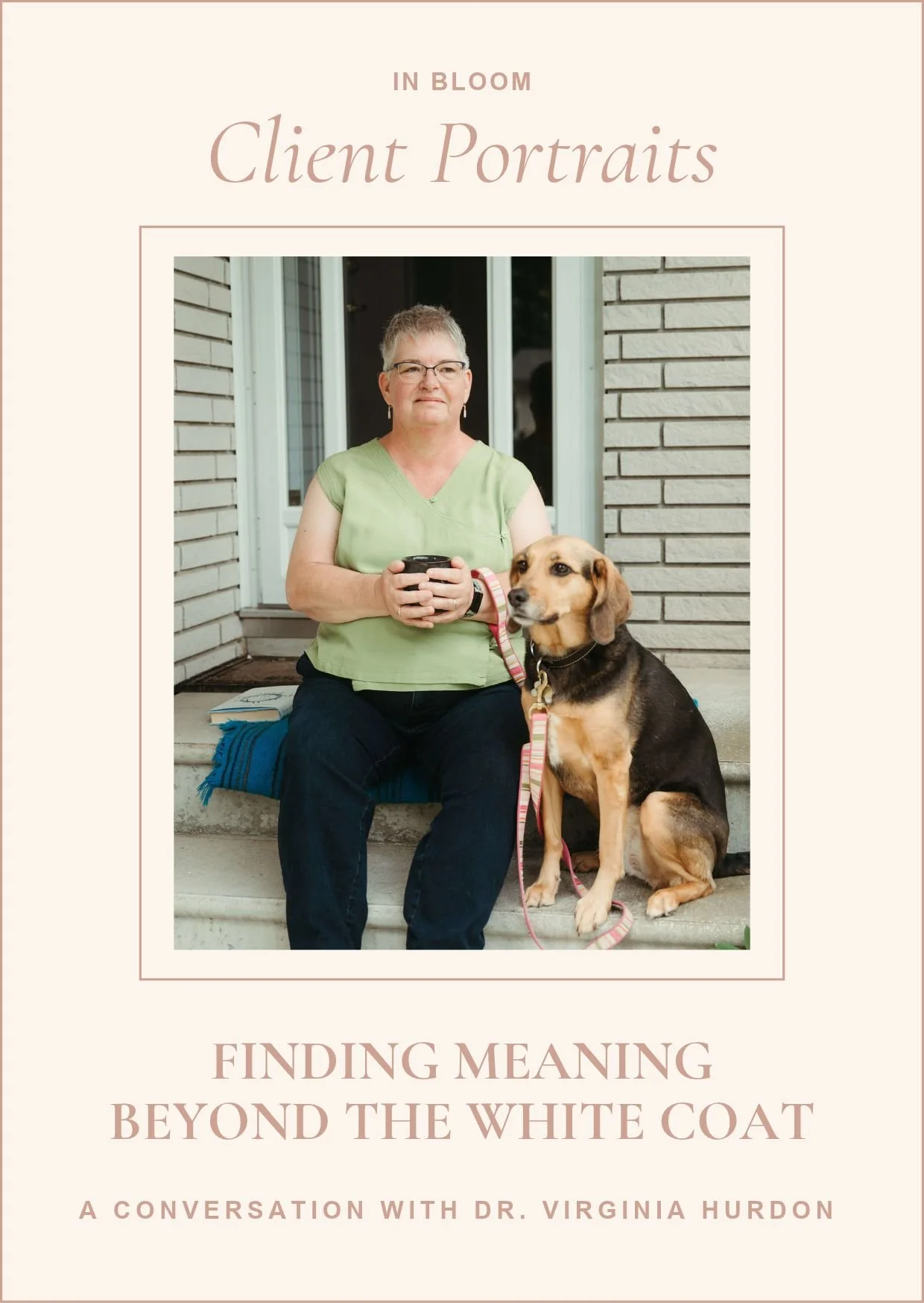
In Bloom: Client Portraits is a series where I reconnect with my clients and hear about their journey. Not just the website, but what led them to build something, put themselves out there, and what’s happening for them now.
The title of this piece is a nod to Virginia's newsletter, Beyond the White Coat, about the gentle shifts, taken one at a time, that can transform a life and career.
Before we started, Virginia asked me to look at a WhatsApp message she had just sent me. It was a photo of her dog, Millie, fast asleep.
"Not only is she sleeping, she's totally slumped," Virginia said. "She's so relaxed that her head is on the floor."
Then she called Millie over to the camera to say hello.

We decided to channel Millie's energy for the interview: relaxed, unhurried, and fully present.
I invited Virginia to this series because I wanted to hear more about her coaching journey.
Virginia and I met in our coach training program, and our paths have stayed connected ever since. I had the honor of designing her brand and website, and I've also been on the other side of her coaching, so I know firsthand the insight, compassion, and artistry she brings to each and every session.
Virginia spent 25 years as a physician in palliative care. Today she is a wellbeing, burnout, and transitions coach for physicians and other medical professionals helping them improve their quality of life.
"I wanted to be Dr. McCoy"
I had never asked Virginia why she chose medicine. It turns out it started at home.
"My mom was a nurse. And I was quite fascinated by what she knew about people from a medical point of view."
Her other influences were Star Trek and M*A*S*H. "I wanted to be Dr. McCoy and have a sarcastic remark for every situation."
She became the first doctor in her family, and she started medical school in the mid-80s with no one to show her the way.
"I had some role models, some doctors that I aspired to be like, but I didn't know them. There wasn't anybody that I could talk to about what medicine is really like."
An unexpected sense of meaning
Virginia calls her path to coaching "a bit unique and kind of serendipitous."
"I was navigating some mental health challenges for quite a while and decided to look into, besides conventional Western medicine, some other types of treatment."
That led her to functional medicine and to Chris Kresser. She valued "the scientific rigor with which he treated things" and his care for people.
"When I found out that he was starting a health coaching program, I said, wait a minute, maybe I can do something related to what I was doing before, but in a much more positive way. So the rest is history. I signed up for their first cohort, and away we went."
I asked her whether coaching has given her the same sense of meaning that medicine did. "It absolutely has been true for coaching, especially when I chose my niche, which was to coach other physicians." Palliative care had taught her what people regret at the end of life.
"People that I had looked after often had regrets, or their families had regrets, about relationships, or about how much time they spent doing work.
And I wanted to have an opportunity to let them know that it could be different, that they too deserve a good quality of life. That…”
“… work doesn't have to be the only source of meaning in life."
It struck me that her coaching is almost like backtracking from what she saw in palliative care. Instead of looking back on regrets, she helps doctors notice what feels like it's missing now, and fill in those spaces, so that hopefully there aren't any regrets.
Virginia agreed. The doctors she coaches know what's missing. What they don't know is how to build a life that includes it and still has room for work.
So much of her work is helping doctors be present in their own lives, "so that they feel like their life is an expression of their whole self, not just one part."
Learning to be fluid and flexible
I asked Virginia whether medicine can feel like all or nothing.
"Oh, that's very common. I think medical culture and medical training often leads us to develop black-and-white or all-or-nothing thinking, especially with the pressure not to make mistakes. And a lot of us come into medicine already with perfectionist tendencies, and that just kind of amplifies them."
Palliative care taught her the opposite.
"Doing palliative care, everything was a gray zone. There was very little that was black and white. We knew the eventual outcome. That wasn't a question; it's the same outcome for all of us. But how someone would get there, and what would happen along the way, and how families would manage, very much a gray zone. And so that needed to be very fluid and flexible."
That flexibility carried right into coaching.
"I think that's something that, as a coach, I do fairly well: adapt to whatever someone's needs are in the moment."
I still remember on a practice coaching call, a fellow coach once described being coached by Virginia as sitting on a fluffy cloud. When I brought it up, Virginia recalled it right away. "I remember the fluffy cloud analogy, too." I completely agree. She has a calm presence that makes you feel everything is going to be okay.

“A fellow coach once described being coached by Virginia as sitting on a fluffy cloud.”
Gratitude for everyday things
Many of the doctors Virginia works with struggle to find meaning outside of their work. One answer she keeps returning to is reclaiming joy in the everyday. I asked her what that means.
"We become very focused on the future and the past: planning, worrying, regretting, the what-ifs. And we forget that we're actually living in this present moment."
During her coach training, she started a gratitude practice for everyday things. A decent night's sleep. Being able to make her own coffee or tea. A daily picture group with her family, where one of her daughters had just sent a photo of the Christmas mantel she'd set up.
"So, you know, small things. But if you don't notice those on purpose, if you're not aware on purpose, you don't notice them. It's just a blur to whatever you're going to next."
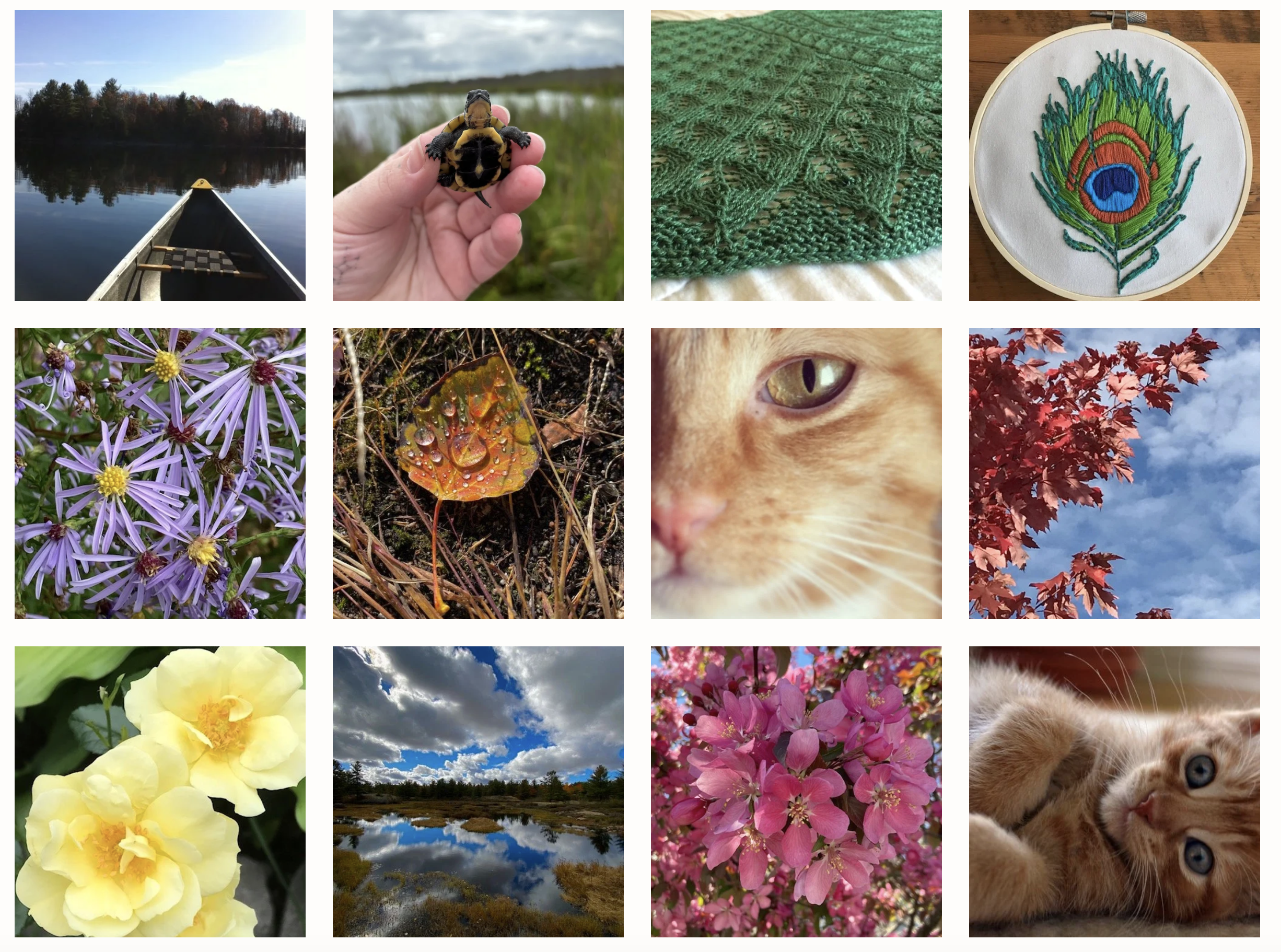
Virginia’s “Snapshots of Joy,” which we shared on her site.
The practice spread.
"I think what's changed is really nothing less than my outlook. My outlook has become much more positive and optimistic. The gratitude practice is one thing. Mindfulness meditation has been another."
The change surprised her.
"I was certainly of the camp, once a pessimist, always a pessimist. People think that's part of your personality. But you can change your perspective. In fact, your perspective changes whether you try to change it or not."
This is a big part of her coaching, too.
"A lot of it is realizing that we have the freedom to choose. Lots of clients want the freedom to choose, but they don't feel they have it, or that they can get it. And so part of the work is to help them see what they do have the freedom to choose, and that they do have the agency to do that."
"We're taught that we're supposed to be invulnerable"
Virginia wants to change something deep in medical culture: the belief that a good doctor is never vulnerable.
Breaking down that stigma, Virginia says, is "one of my missions." It's why she shares her story.
"I think that's really important to get the story out there, and to try to reduce some of the stigma around mental health challenges as a doctor, or needing to take a leave, or even physical illness challenges.
Because we're taught that we're supposed to be invulnerable. And of course, that's not true, because we are human beings."
I asked her whether, for a physician, being vulnerable feels like a sign of weakness or a sign of failure.
"Both. And we're taught by example that if you're vulnerable, not only are you weak and a failure, but you're also not a good doctor. Having been a physician for 25 years, and working in the area that I worked, I know that's not true."
The stigma comes from other doctors, too. "It's definitely considered a weakness and something you don't share, especially with your colleagues."
Then she remembered a photo.
"When I went to medical school, at the end of the first year, our class had a class picture. And everybody in that picture was expected to graduate. There wasn't another class picture at the end of the four years."
"Talk about pressure. Talk about a feeling of failure, because there were a couple of people who dropped out."
Right now, Virginia is changing this one client at a time, and through anyone who finds her website. She is also open to speaking about her story to larger groups. She knows it will take time.
She isn't doing it alone. A Facebook group for female physicians showed her she wasn't the only one.
"That kind of sharing didn't exist when I was in practice. So my willingness to share has come at a good time, I think, in terms of the whole profession. But I definitely see myself as being part of that movement as well."
"It took a long time for me to realize. It took my burnout and breakdown, and starting to recover, to realize just how messed up medical culture is."
"Now I have that solid ground"
I asked Virginia what was going on in her coaching when she first reached out to me about her website.
"Well, to be honest, zero was going on in my coaching. And I wanted to change that."
She had built her first site herself. "I had basically a self-made, homemade website, which probably wasn't a very good reflection of the kind of clients I was trying to attract."
"The experience of putting together my new website with you was fabulous, because you could help me express all of that in a warm and professional way, without needing to give all the details. My previous website was a lot about me and not so much about the people who might benefit from my services. And so you really helped me turn the story around and be much more about those people."
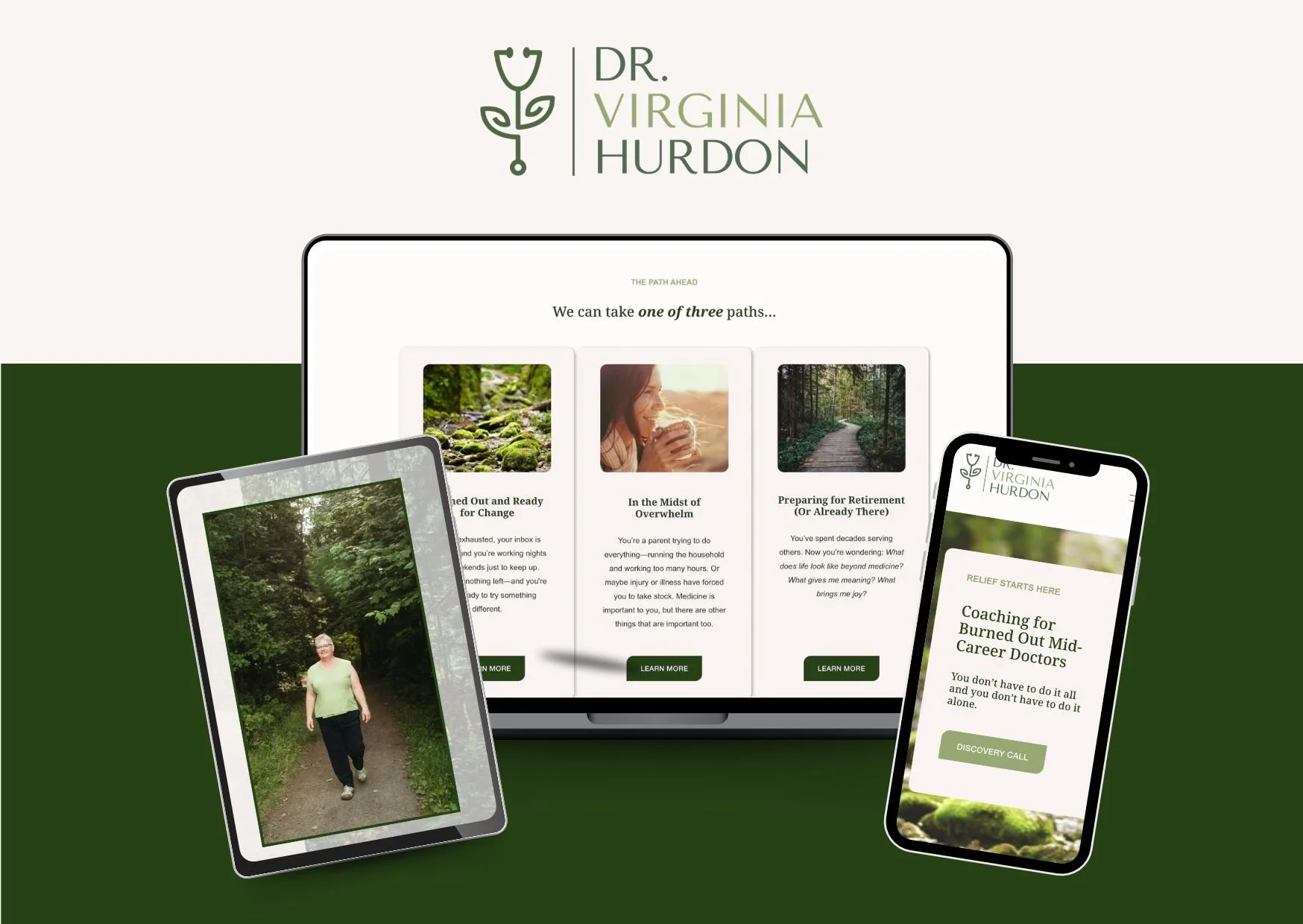
The goal was for her readers to recognize themselves on the page. "And if you can see yourself as a potential client, that's much more effective."
The site changed something for Virginia, too.
"It's given me a lot more confidence, and it really helped me define my niche as well, in a very solid way, because there's proof out there for anybody to read about who I work with. And it's kind of grounded me."
I asked her to tell me more about that grounding.
"I realize I work with three different groups of people, but they're facing a lot of the same issues. And the process with you of making the website really crystallized that for me. Now I have that solid ground."
Virginia's words to you
Many of the women I work with are sharing something deeply meaningful to them. I asked Virginia what she would say to a woman who is struggling to put herself out there.
"I would say don't wait until you feel confident about it. Because it works the other way around. When you share, you'll become confident."
"The other thing is that if it's meaningful to you, it's likely meaningful to a lot of other people. Human beings, while we're all individuals, we're also all very much the same. And you may not actually feel it until you've shared it, and other people go, wow, that's me. I can really relate to that."
Thank you, Virginia, for reminding us that our lives can hold meaning far beyond our work, one small moment at a time. Millie would approve.
Visit Virginia at www.virginiahurdon.ca